Sunday, March 22, 2020

Cuban-inspired Great American Turkey Fritas: Burger Bash 2020 Contest Winner


Can’t stand it when you click on a link for a recipe then must wade through someone’s life story before you get to the goods, so here’s the recipe first, then the story:


Cuban-inspired Great American Turkey Fritas

Ingredients (See Note)
Great American Turkey Smoky & Sweet Chili Turkey Breast Strips 
Egg
Half slice of white or Italian bread or approx 1/4 cup plain breadcrumbs
Potato Sticks
Sliced Avocado
Onion

Seasonings
Garlic
Smoked paprika


Method
Pulse 2-3 small garlic cloves and approx. ¼ cup of onion in food processor until soft and combined. Add turkey strips and liquid from package and pulse again to grind (but not liquify) turkey. Scrape from food processor and put in mixing bowl. Add a slice of bread to food processor, pulse and add to mixing bowl (or add a half a cup of plain breadcrumbs. Crack an egg and blend mixture, then make four equal-size balls. Let rest for 20 minutes.

Heat a heavy frying pan and add just enough olive oil to cover. When oil shimmers, add each ball, fry for a minute, then flip and press into a patty with spatula. Fry until desired doneness then serve on brioche, dust with smoked paprika topped with potato sticks accompanied by avocado slice and (optional) roasted pimento garnish.


Note
This was my contest entry for a competition sponsored by The Great American Turkey Company, for “an original, Latin-inspired food recipe using one of Sponsor’s six provided turkey products ("Food Recipe") and up to, but no more than, five (5) additional ingredients of contestant’s choosing (this excludes cooking oil, seasonings and spices).” Each of the top four recipe creators would win a ticket to an event at the South Beach Wine and Food Festival (SOBEWFF) Lucky me! I won a ticket to Burger Bash


I'm impressed with the products they sent and the company's approach. You can read more about them here.
Me and Great American Turkey Company co-founder and President George Faison

Wednesday, March 18, 2020

Pastrami from Corned Beef?


Not exactly. Purists can leave now but I managed to make a pretty tasty simulation using a point-cut corned beef.

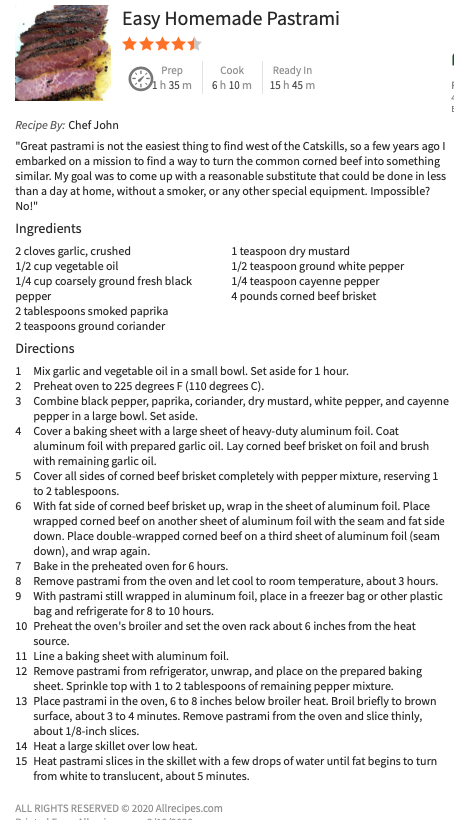
I used this recipe posted below (video link here) as my guide with several modifications:
  • First of all, I had a tiny 2-lb brisket, so I probably should've halved the proportions but I didn't. I also added the contents of the little packet that came with the brisket, which was mostly coriander seeds, plus a pinch of allspice because that adds a nice rounded note.
  • The recipe calls for triple-wrapping the seasoned brisket but I have trust issues, so I quadruple-wrapped it in heavy-duty foil.
  • The recipe said to bake it for six hours at 225° but I did it for 250° for four and a half hours.
  • Recipe said let it cool overnight but I was busy so it sat in the fridge for two days. 
  • Recipe said take it out, sprinkle leftover rub, then broil, then slice. Nope. I sliced it cold, then sprinkled and broiled. I didn't reheat it with water, either, since it was already pretty moist. The result is pictured above.
Taste was good; definite pastrami notes and the texture was excellent, probably because the source, a point-cut from Aldi, was quite good; well-trimmed and not too salty. (I'd made it as a straight-up corned beef in my pressure cooker a couple of weeks earlier.)


So what would I do differently next time?

Might dry it a bit more before cooking. I realize these things are pumped with liquids but it seemed a bit wet. Also, maybe wrap and cook on low in my slow cooker instead of the oven for economy's sake. I'd also reduce the pepper and use some liquid smoke and more smoked paprika because it just wasn't very smokey.

But overall, I was quite pleased with the result and will press forward in the name of science — and pastrami!

Here's the original recipe I modified.


Saturday, October 6, 2018

Slow-Cooked Southwestern-Style Chicken

Ingredients
5 lbs. chicken legs or thighs or drumsticks (rinsed, skinned and most fat removed)
2 large bell peppers (seeded and cut into inch-square pieces
2 onions (rough-chopped)
8 cloves of garlic (minced)
2 tbs. dry oregano
1 tsp. cumin
1 tbs. salt
1/2 tsp. ground arbol chili pepper (or cayenne to taste)
1/2 tsp. smoked paprika
1/2 tsp. ground cumin
1/2 tsp. ground coriander
3-4 bay leaves
1/2 cup chunky salsa

Chicken legs are where the flavor is. Breasts are fine, if you like 'em, but more of a tabula rasa, and bland. They also tend to not do well in slow cookers, and can get dry and stringy. Feel free to substitute them in this recipe, if you like, but you've been warned.

Method
After you skin, wash and remove as much fat as you can, put the legs in a large stainless steel bowl. Drain excess liquid and add the rest of the ingredients except the salsa and bay leaves. Mix well by hand or with a spatula (or whatever implement you like). Make sure the seasonings are evenly distributed over the chicken and the onions, minced garlic and peppers are in the mix, too.

Layer the legs in the slow-cooker, with onions and peppers, placing bay leaves between pieces. Cover with salsa. Cook on low for an hour, then low 4-5 hours. Temperatures vary on slow cookers, so be careful not to overcook.

You can serve these legs with rice, refried beans, guac and chips, or strip the meat from the bones and use for tacos, burritos or (my preference) enchiladas. You can also cool 'em and make chicken salad.


Tuesday, October 3, 2017

Pickles, Green Tomatoes and Cole Slaw

HARRY KRAMER’S KOSHER-STYLE DILL PICKLES
Take a clean jar, from a quart size to a gallon size. Wash 6 to 13 small Kirby cucumbers, depending on the size of the jar. Put 1 heavy teaspoonful of commercial pickling spices into the jar. Add 6 to 8 garlic cloves, unpeeled, which you’ve sliced in a few places, without cutting all the way through the clove. Pack the cucumbers into the jar whole. If you like, put in a bit of fresh dill weed. If you like a “perked up” flavor, add 4 to 6 dried red chili peppers. Add 3 to 4 ounces of white vinegar. Fill a measuring cup with tap water hot enough to dissolve salt. To each cup of water add 1 teaspoon of salt and stir to thoroughly dissolve. Pour the water into the jar, cupful by cupful, until the jar is full. Cover and leave on the kitchen counter for two days. They are now ready to eat. Keep refrigerated. The pickles will stay good for months.
Notes: The pickles were not analyzed since the amount of sodium absorbed during preparation cannot be determined.

HARRY KRAMER’S PICKLED GREEN TOMATOES
Take any size jar, 32 ounces or larger, and line the bottom with celery cuttings — leaves or stalks or both. Add 6 to 8 peeled and pierced garlic cloves. Pack cleaned and sectioned green tomatoes into the jar (you’ll need about 3 small to medium green tomatoes with no red showing on the skin). Add 3 to 4 ounces of white vinegar. Now fill the jar with 1 cup of hot tap water mixed with 1 teaspoon of salt. Keep adding the salted water until the tomatoes are completely covered. Cover the jar and let sit out for 2 days. Refrigerate. Keeps months in refrigerator. Makes about 12 servings of 1⁄4 tomato each.
Notes: The pickles were not analyzed since the amount of sodium absorbed during preparation cannot be determined.

OLD MIAMI BEACH DELI-STYLE COLESLAW
1 medium (about 1 pound) cabbage
1 green bell pepper
1 medium onion
1⁄4 cup vegetable oil
1⁄4 cup vinegar
1⁄4 cup sugar
Salt and pepper to taste
Shred the cabbage very fine; you should have about 4 cups. Slice onion and bell pepper into very thin slices. Combine oil, vinegar and sugar in a lidded jar; shake well to mix. Pour over the slaw mixture and toss to blend. Makes 8 (1⁄2 cup) servings.

Source: Linda Cicero's Cook's Corner column in the Miami Herald, retrieved here

Wednesday, January 27, 2016

Review: The Burning Oak

The Burning Oak
8006 W McNab Rd
North Lauderdale, FL 33068

Reviewed 1/26/16

Two visits and I'm hooked. REAL wood/smoked barbeque! 

First visit, tried the ribs: meaty, smokey and delicious. Great sauce, too, but the rub and smoke added more than sufficient flavor. Corn bread was good (needs a little work but quite acceptable) and the coleslaw was good, too (not Shorty's-good but good).

My friend had the chicken and I could not believe how moist and tender it was.

I NEVER order barbequed chicken out because it's always dry and nearly flavorless but this was different; even the breast was juicy.

Second visit, ordered the chicken; beautiful, juicy barbequed half chicken (and not one of those mutant miniature birds they serve at Boston Market — full sized!). It was delicious and I could barely finish it. The corn bread was a little better this time and the collard greens were terrific; tasty with bits of pork for flavor. Nice!

My friend had the pulled pork sandwich and It was quite good, too, based on the sample he provided. ;)

I may revisit this review and give them five stars after a few more visits (and when they smooth out a few little rough spots, service-wise; nothing major but a little less than perfect. No problems but not a five-star experience — yet.).

In the meantime, this is definitely among the top five places for 'que in South Florida. Kudos!


Monday, March 10, 2014

Mu Shu Pork or Chicken

a/k/a Asian Burrito


This is my version of the Chinese restaurant favorite. It's not authentic but it's good!

For convenience, I've substituted tortillas for the thin and very perishable pancakes. If you want to forgo them and just serve this with rice or noodles, you have my blessings. Enjoy!


Ingredients
Total 3 cups shredded cabbage, carrots, onion and mushrooms (see note)
1/2 cup Canola oil
1 tsp. sesame oil
1/2 tsp. white pepper
3 cloves garlic, minced
1 tbs. minced fresh ginger
1 tbs. soy sauce
1 cup chicken stock
1 cup water
10" tortillas
1 cup Hoisin sauce
1 tbs. corn starch
Approx. 1-1.5 pound lean boneless pork or chicken (preferably thighs) cut into thin strips

Notes
You can use pre-made coleslaw mix, if you like, or simply shred some green cabbage, a couple of carrots, about a quarter of an onion (more or less, according to preference) and thinly slice about 4-5 white mushrooms.

Method
Heat wok (or heavy frying pan) and add about a tbs of oil, then half the garlic and ginger. Let it sizzle a bit and stir. Then add vegetables and soy sauce. Stir frequently, add white pepper and sesame oil and half the water. Stir well and cook until wilted. Remove from wok. Set aside, cover and keep warm.

Wipe wok with paper towel. Add about a tbs of oil, then the other half of the garlic and ginger. Let it sizzle a bit and stir, then add pork (or chicken) and stir rapidly until done, then remove from wok; add to wilted vegetables; cover and keep warm.

Add chicken stock to hot wok. Dissolve cornstarch in half cup of water, then add to hot stock and stir. Add about a tbs. of hoisin sauce, then add pork (or chicken) and vegetable combination. Stir and mix well.

To serve, lay a tortilla out on a plate. Spread a little hoisin sauce in the middle and add some of the pork (or chicken) and vegetable combination. Roll like a burrito and serve.

Saturday, November 16, 2013

Bacon Cheddar Spinach Quiche

Richard Pachter
8 oz. (1/2 lb.) Applewood smoked bacon
8 oz. (1/2 lb.) extra sharp cheddar (or cheese of your choice; Swiss, Gruyere etc.)
10 oz. bag fresh baby spinach (see notes)
5 jumbo eggs
8 oz. (1/2 pt.) heavy (whipping) cream
1/2 tsp. fresh ground black pepper
1 tbs. chopped onion
Pie crust (see notes)

Cook bacon in a large pan. When crisp, remove from pan, drain on paper towels and cool. Reserve 1 tbs. of bacon drippings to grease pie pan (in place of shortening).
Put uncooked spinach in pan with remainder of bacon drippings. Cover and allow to wilt. Do not overcook. When cooked, allow to cool, then squeeze with paper towels to remove as much moisture as possible.
Shred cheese. Combine with eggs, cream, pepper and onion.
Chop cooled bacon and spinach into strips or irregular pieces. Add to egg mixture. Pour into pie crust in pie pan. Bake at 425° for approx. 30 minutes (see notes). Quiche is done when pie crust is slightly golden and toothpicks come through clean. Allow to sit five minutes before slicing.

Notes: I used fresh baby spinach, reserving a few leaves to top the quiche. If fresh is unavailable, thawed, well-drained frozen spinach can substitute.
You can use a homemade pie crust, if you like. I buy the pre-made pre-cut dough (two per package) and roll one
out, reserving the second for later use.
I used a tabletop convection toaster oven. Temperature and cooking time could vary if using a conventional oven.

Friday, November 9, 2012

Chili Today, Hot Tamale

The Friggin' Gourmet
photo by Phil Soriano
I was in a chili cook-off today at work. Skipping the suspense and avoiding a setup and punchline, I won.

Ego trip aside, it was a little odd. I've never cooked competitively. (I've eaten competitively — a sushi-eating contest at the Morakami Museum — and it was disgusting.)

But this was a lot of fun and for a good cause; abandoned doggies. The event raised $900 which was great!

My big regret (aside from not being able to have my chili for lunch since it sold out pretty quickly) was not tasting the seven other entries. (I tried one.)

But it was very flattering, of course, to have people come up to me and tell me how much they liked my chili, that I should open a restaurant and sell chili dogs (yeah, right) or ask for my "secret ingredient."

Secret ingredient? Ha! I'm Mr. Transparent when it comes to food, so I'm happy to share.

But I didn't use a recipe, so I'm just going to list the ingredients and encourage experimentation. And other than a few items, no amounts are specified since I didn't keep track. This isn't science but craft.

Oh, and while this chili isn't hot, hot, hot (a/k/a Three-Mile Island Chili), it has depth and presence. I went for a bit of complexity and succeeded but it's not mild or bland, so if that's what you prefer, this is not for you. And despite the photo, actual cooking (and reheating the next morning) was done in a pot on top of the stove; the slow cooker was used only for serving.

Have at it!

Ingredients
approx. 3 lbs. ground chuck
approx 1 lb. loose Italian sausage
canola oil
4 15-oz. cans chili beans
2 15-oz. cans diced tomatoes
2 diced onions
onion powder
garlic cloves
garlic powder
Kosher salt
soy sauce
2 roasted red bell peppers
fresh ground black pepper
white pepper
cayenne
Louisiana hot sauce
honey
cumin
turmeric
oregano
allspice

Toppings
thinly sliced green onions
sliced jalapeño peppers
(Optional: shredded cheddar, sour cream)

Sunday, September 2, 2012

Spell It Barbeque, Barbecue, BBQ or Bar-B-Q, South Florida Has the Real Thing

For purists, barbecue is a process and not a product. No disrespect to the school of low and slow cuisine, but we’re going to focus here on what’s on the plate.

Though some claim that in Florida, the further south you travel, the further north it seems, South Florida is a mecca for southern-style barbecue.

But what exactly is barbecue?

To many, the term “barbecue” (or BBQ, Bar-B-Q or barbeque) is unquestionably synonymous with all manner of grilled foods: Hot dogs, hamburgers, turkey burgers, veggie patties, baby back ribs, chicken wings and any other fire-roasted, grilled edibles. That’s barbecue. Or is it?

To devotees, “barbecue” means pork spareribs, pork shoulder, beef brisket, sausage, chicken and turkey, rubbed with spices and cooked slowly over low dry heat, flavored with the smoke of hardwood — preferably hickory — with sauce optional.

For purists, barbecue is a process and not a product. It’s strict, and its qualities are defined by experts, many of whom cook and compete based on a rigorous set of standards.

No disrespect to ardent followers of this venerable school of low and slow cuisine, but we’re going to focus here on what’s on the plate and not in the kitchen (or in the pit).

Like most of the country, South Florida has a plethora of popular national chains, serving steaming heaps of sauce-slathered, moist-cooked ribs and chicken finished in a hot oven or on a grill. They call it “barbecue” and that will suffice for most of their customers, who blissfully believe they’re eating the genuine article (or haven’t really given it much thought either way).

But for those who crave a bit more authenticity on their plate and in their mouth, South Florida offers a number of tasty options.

Here’s a look at some favorite SoFla stops for ’que.

Scruby’s has three locations in Broward (Davie, Pembroke Pines and Tamarac). They brag that their baby back ribs dish is their top seller, but pork spare ribs here are consistently meaty, smoky and very satisfying. They also serve beef brisket and chicken wings, and a rich and tasty Brunswick stew. Even nachos (!) are on the menu. Smoked chicken is quite good, and the usual retinue of side dishes is also top-notch. Sweet Corn Nuggets, a fried and breaded starter served with butter and honey, is a popular offering.

Shorty’s began their rib reign in South Miami circa 1951. The original building burned down in 1972, was rebuilt on the same spot and later heavily damaged during Hurricane Andrew in 1992. After rebuilding yet again, the crew also expanded north and west to Davie, Deerfield Beach, Doral and West Miami. The solid menu of ribs, pork, pork steaks and chicken is supplanted with burgers and a local south Florida favorite, churrasco (grilled skirt steak). The side dishes are all very good, but the tangy cole slaw is exceptional. Tip: Be sure to check their website for printable discount coupons before visiting.

Sonny’s is a regional chain, founded in 1968, with 127 locations dotted throughout Florida and the Southeast. Based in Maitland, near Orlando, their log-cabin-esque locations were formerly ubiquitous in South Florida, but they’re now down to single spots in Broward (Davie) and Miami-Dade (Florida City, south of Homestead). In addition to their popular spare ribs, the menu includes reliable favorites like baby backs, brisket, chicken, turkey, sliced and pulled pork, and Brunswick stew. There’s also a (gasp!) salad bar with a good selection of greens and accompaniments.

For some SoFla barbecue aficionados, Tom Jenkins’ homey downtown Fort Lauderdale eatery is the gold standard for the area. Their menu of pit-smoked pork, ribs, brisket and chicken offers consistently excellent barbecue every day (except Sunday). They also serve fried catfish and stellar sides, including collard greens, corn on the cob, coleslaw, baked beans and macaroni and cheese. The single location is country-casual and takes no reservations, but the barbecue is as good as it gets – anywhere. If you’re picking up or dropping off at the nearby Fort Lauderdale-Hollywood International Airport, this is well worth a side trip.

There are a number of other single locations dotted throughout south Florida. (Wish we could cover them all. Maybe we’ll continue this tour down the road.)

One example, Dixie Pig (no website; here's the Yelp listing) – an unassuming little stand on Dixie Highway just south of Commercial Boulevard in a mixed business area of Oakland Park – states unambiguously that they serve “Real North Carolina ‘Vinegar Base’ BBQ,” and so they do – outside, no less. There’s no interior seating here, though the tables are all under cover, in case the weather doesn’t cooperate. Pulled pork, chicken and beef are the stars, but the ribs are excellent, too. Breakfast is served as well, with omelets that include their barbecued meats, along with the usual fillings. They offer a surprisingly diverse menu with meatloaf, hoagies, fried chicken and more, but their terrific barbecue is the best reason to visit.

If You Go


Dixie Pig
4495 North Dixie Highway
Oakland Park, Fl 33334
954-772-1551

Scruby’s BBQ
8990 W State Road 84
Davie, FL 33324-4457
954-370-2774

Shorty’s Bar-B-Q (5 locations)
South Miami (#1)
9200 South Dixie Hwy
Miami, FL 33156
305-670-7732

Sonny’s Bar-B-Q
(various locations)
2699 S. University Drive
Davie, FL 33328
954-476-7611

Tom Jenkins’ Bar-B-Q
1236 South Federal Highway
Fort Lauderdale, FL 33316
954-522-5046

Originally posted at VisitFlorida.com 

Friday, May 25, 2012

Butternut Squash Ravioli

This isn't as much a recipe as it is a plan. The amounts here are far from exact but the process is pretty idiot-proof, so no worries!
What you need
About a cup of cooked butternut squash.
I usually slice 'em, scrape out (and discard) the seeds and fibers, sprinkle a little salt and pepper, turn upside down on a plate and nuke for about ten minutes. Allow to cool, then scoop out the cooked squash.

Wonton Skins.
The ones I used are 3.5 inches square.
They're available in the produce section of your supermarket or you can get 'em here.

Salt and pepper to taste (as they say)
2 cloves of garlic
Butter and olive oil
1 egg, separated (yolk and white)
Sage leaves (or dried sage).
-->
Parmigiano Reggiano cheese
Nutmeg and allspice (optional).

What you do

Filling
Mash up the cooked butternut squash in a mixing bowl. Taste it. If it's sweet, just put in a little salt and pepper. Sometimes, the squash is a bit bland, so you might need to add a little allspice and nutmeg (about a half teaspoon of each) to bump up the flavor. You can also add a teaspoon of honey, if you like it to be even sweeter.
Add the egg yolk to the squash and mix thoroughly. Let stand.

The wraps
Open your package of wonton skins and take out a stack. You should be able to make about 20-24 with the squash. The wonton skins can dry out pretty quickly, so cover them with a wet paper towel.
Beat the egg white and keep it near the stack of skins.
You don't need this —and I was prepared to make this by hand — but I remembered that I had this dumpling press (pictured below) stashed away in a drawer. 
What do you know! It was the perfect size for the wonton skins. (If you want to purchase one, click on the image or here.)
The procedure is to take a wonton skin, lay it on a flat surface (or within the dumpling press). Put about half a teaspoonful of the squash in the middle of the wrapper. With your finger (or a brush, if you're prissy), spread some egg white around the edge of the skin. Close the press (or fold the filled wonton skin with your fingers), sealing the edges together. You should have a tight, filled package with as little air as possible and no squash seeping through.

Lay each filled and sealed wonton skin on a flat surface to dry.
You'll have about 20 or so with about a cup of squash. If you have wonton skins left over, reseal and use soon. They will dry out, so use 'em or lose 'em.
Fill a pot with water, add salt and boil your (ta da!) ravioli.
You don't need a violent, rapid boil, just a bit of bubbling.
Use a wooden spoon (or whatever) to keep them from sticking to the bottom of the pot.
The ravioli will be done in about 5 minutes or less, so don't overcook.

In the meantime, heat a large, flat pan; low-medium heat, and add  2 tbs. butter.
You don't want the butter to sputter and crackle, just melt and slowly brown. 
Smash your 2 garlic cloves against the flat blade of a large knife on a cutting board. Add to the melting butter. 
Keep the heat low; you don't want to burn the garlic.

When the ravioli are done, remove from water and drain.
By this time, the butter should be starting to darken. Turn heat down to low. 
Drizzle in about a tablespoon of olive oil and blend with the butter. 
Add the ravioli and gently mix. Add more olive oil, if needed.
If you have sage leaves, add them now or sprinkle just a bit or ground sage. Salt and pepper to taste. 
Serve with grated Parmigiano Reggiano cheese.

Friday, May 4, 2012

Slow-Roasted Beef Brisket

Ingredients
1 beef brisket approx 4-5 lbs
1 tsp each kosher or sea salt, black pepper, garlic powder, onion powder, paprika (pref. smoked)
1 tbs liquid smoke (optional)
1 tbs olive oil
1 large onion.

Method
Remove brisket from refrigerator and allow to come to room temperature.
Preheat oven to 200° F.
Drizzle and spread olive oil on the bottom of a roasting pan, just enough to cover surface of the pan. Use as little oil as necessary to cover surface.
Wipe brisket with a paper towel.
Place brisket fat-side down on roasting pan (in the olive oil). (It's not necessary to trim fat but if it seems excessive, feel free.)
Combine dry ingredients and use half to rub on top of brisket, then turn over (fat-side up) and rub remainder on.
Drizzle a bit of the liquid smoke on top (optional).
Cut onion into thick slices and place flat on brisket.

Roast for 8 hours at 200° F., remove from oven, place on cutting board and slice thinly across grain. Top with your favorite barbecue sauce (optional).
Serve with Cole slaw, beans, mashed potatoes and the onion slices.

Saturday, October 22, 2011

Toa Toa in Sunrise


Dim Sum "Of The Heart"

By Richard Pachter

In business, we're taught to always have a "Plan B," but I'd add that it's wise to make sure that the alternative is as good or better than the original.

In other words, when you're dealt lemons, don't just make lemonade — make a lemon daiquiri!

One recent afternoon, I invited a group of music producers and audio teachers from The Art Institute of Fort Lauderdale for lunch at a west Broward Japanese-Thai-Vietnamese emporium, but when I arrived early, it was closed!

Fortunately, Toa Toa, one of South Florida's very best Chinese restaurants, was nearby and for our group, the substitution turned out to be fortuitous.


Situated in a cool corner of an expansive shopping center in Sunrise, Toa Toa is a reliable purveyor of Cantonese, Mandarin, Hunan and Szechwan favorites. It also excels in the popular dishes customized for American palates such as chicken chow mein, shrimp with lobster sauce, beef lo mein and the like.

But the best thing about Toa Toa is its delightful dim sum. Dim sum, which means "of the heart," originated in Canton's tea houses.

Each order consists of a single, small portion of steamed or fried dumplings, buns, stuffed vegetables, noodles, meats, fish, or steaming bowls of soup with noodles, shrimp, fish, meat, and vegetables. A meal consists of an array of these small plates, usually shared among several people, family-style.

For business lunches, a meal of dim sum at Toa Toa is a powerful catalyst for instant conviviality. You might not want to invite a stuffy, uptight client or boss for lunch here, unless, of course, they are predisposed toward lightening up a bit or you know they love Chinese cuisine.

But its scrumptious little plates, efficient service and reasonable prices make Toa Toa the ideal spot for a friendly repast, for business or pleasure. Plus, the variety and staggered arrival of each dish provides convenient pauses for lively conversation.

Our group of eight was seated after a very short wait. The server handed us a slender paper menu listing each of the available items in English and Chinese. A "regular" menu was also included, as was a laminated pictorial guide to the dim sum dishes, along with a pencil.

I wrote the desired number of portions of each item on the menu and handed it back to the server after announcing the choices our group would share to my assenting guests.

Shrimp dumplings are usually a favorite, so four orders of the four-dumpling dish were requested. We also ordered multiple portions of siu mei (wonton skins filled with a pork and shrimp mixture); stuffed eggplant; beef rice paste (a flat rice dumpling filled with chopped and seasoned beef); steamed pork and chicken dumplings (which had an airy pastry-like texture); fried crab claws and silver noodles, which resembled malformed bean sprout shafts combined with strips of scrambled egg, shrimp and roast pork. Yum!

Each dish arrived at our table hot from the kitchen. First up were the shrimp dumplings. A splash of soy sauce and a drizzle of (spicy) chili oil gave them an extra kick.

Audio engineer Ed Mashal, one of my guests (check the credits of your copy of the Eagles album "Hotel California"), declared that it was "fantastic!" He doesn't eat meat, so he passed on the siu mei, which appeared shortly thereafter, but Russ Ben-Ezzer and Brian Campbell, partners of StepBrother Productions (www.stepbro.com), devoured them with gusto — and chili oil.

Ray Dawson of Deerfield's Zero Digital noted that "the prices here are amazing."

Indeed. They ranged from $2.45 for the shrimp dumplings to $5.95 for the silver noodles (take-out and dinner prices are slightly higher). The eight of us stuffed ourselves for under $80 plus tip. True, if we'd ordered drinks, the tab would have increased, but the hot tea was the ideal accompaniment for the steamed and fried dishes.


Logistics
  • Rating: Terrific food — and the price is more than right.
  • Details: Located in an outdoor shopping center with ample parking.
The Basics
  • Address: 4145 NW 88th Ave., Sunrise (Pine Plaza). 954-746-8833.
  • Type of food: Mandarin, Hunan, Szechwan and Cantonese favorites, especially dim sum.
  • Average prices: Approximately $10 per person for lots of small plates and hot tea.
  • Service: Friendly, helpful and non-intrusive.
  • Atmosphere: Broward neighborhood, family Chinese.
  • Best for: Inducing or reinforcing instant conviviality and a spirit of sharing among business colleagues.
  • Linger factor: Until drowsy.
  • Hours: Monday, Tuesday and Thursday: 11 a.m. to 10 p.m.; Friday and Saturday: 11 a.m. to 10:30 p.m.; Sunday: 10:30 a.m. to 10 p.m. Closed Wednesday.
  • Credit cards: Visa, MasterCard, American Express, Discover.
  • Reservations: Not necessary, but not a bad idea for larger parties. 
  • Website: http://www.toatoachineserestaurant.com
Originally published 2005 in the Miami Herald

Thursday, August 4, 2011

MasterChef Magazine

I used to subscribe to several— well, many — food and cooking magazines; Gourmet, Food & Wine and a zillion others on and off over the years. And like most gourmands, I dig the hell out of reading cookbooks. In fact, I'll be posting some reviews soon of some of my old faves and new ones, too.

I'm not a regular viewer of Gordon Ramsay's TV shows. I hear he's a terrific chef, but the shouting, drama and humiliation don't appeal to me. I did like a solo show by Ramsay (Gordon's Great Escape) where he toured several Asian countries and cooked. That was a blast!

Recently, I got a copy of a cooking magazine based on his MasterChef show. The publisher (actually, its publicist) referred to this as a "bookazine," and though I'm not nuts about that clunky neologism, the 144-page issue is brimming with recipes, features, profiles and absolutely gorgeous photography — all devoted to food and technique, with a little bit of personalty stuff larded through the text, though thankfully not enough to dominate the proceedings.

Along with Ramsay, fellow MasterChef hosts Joe Bastianich and Graham Elliot are featured. (Bastianich, by the way, is business partners with my old pal, Mario Batali. Nice!) And sure, there's little tidbits about their lives and personalities — even something about their moms (Joe's is the famous Lidia Bastianich, no slouch herself!) but not enough to turn this into a pie-eyed celebrity magazine, thankfully.

In addition to those guys, there's a nice piece on crab cakes by ubiquitous food writers Jane and Michael Stern (with recipes, of course), as well as plenty of content from the show's participants, all pretty good chefs in their own right. There's also a helpful recipe index in the back, like all good food magazines and books!

I'll have to run a few of the recipes here. Some are a little too precious and froufrou for me, personally, but there's a bunch that are appealing and relatively straightforward. Pollo Con Futtas looked really tasty!

In any event, it's on newstands now and if you'd like to grab something worth reading and rereading, and will probably get stained by sauce and oil and whatnot from your kitchen while you're cooking some of the things herein, give MasterChef a shot.

Sunday, January 3, 2010

Monday, May 18, 2009

Potluck Potato Kugel

You can make kugel with zuchini, potatoes and probably lots of other vegetables. It's basically an egg pudding.
Here's a version I threw together last night that was quite good.


Potluck Potato Kügel

Feel free to add and subtract things that make sense (ex. cooked or grated carrots).
This will probably work with up to a cup of leftover mashed potatoes. I had about 2/3 cup.

Add about 1 tbs. each chopped green pepper, celery and onion. 1 minced garlic clove. Salt and pepper to taste. (I used white pepper.)

2 jumbo eggs.

A little (1-2 tbs.) matzo meal, cracker meal or breadcrumbs.

A dash of turmeric (for health and color.) A dash of smoked paprika (can't hurt!)

1 tbs. rendered chicken fat or olive oil if you're not into the schmaltz.

Mix well with a fork. Pour into a greased oven-proof dish (I used a Pyrex bowl). Allow room for it to rise about 50%.

Bake in a tabletop convection oven (a/k/a glorified toaster oven) at 425° for approx. 25 minutes until golden (not burnt) brown.

Allow to cool slightly before serving.

Probably works in a conventional oven, too. Lemme know.

Thursday, January 22, 2009

Feed a cold and feed a fever


Got a cold? Feel one coming on? Or just feel blah. Here's what you need...

Almost every neighborhood Chinese restaurant I've encountered has something on the menu called "house special won ton soup" or "ten-ingredient soup," made up of broth, roast pork, chicken, shrimp and vegetables plus a few won tons. (If you don't eat meat or chicken or shrimp, decent restaurants will be happy to accommodate your needs and if not, keep going until you find one!)

The soup is usually pretty good as-is but if you can get it to-go, grab a quart (about $5-$6), bring it home, add some raw onions, chopped fresh garlic, celery, cayenne and any other vegetables you have around: Carrots, bell pepper, mushrooms, jalapenos... like that. And if you have any cooked chicken, why the hell not. Tofu, too, if you like.

Tabasco or other hot sauce should be added to taste.

And if you want to dump in some cooked rice or noodles, sure. Ramen noodles will work, too.

You will feel better while you eat it, at the very least, guaranteed.

Thursday, December 4, 2008

Deep Fried Turkey Parts


Well, after extensive research, I've concluded that it's not worth doing. If you like deep frying a whole turkey, well yeah, do the parts separately in the same drum or other conveyance you do the whole bird in — preferably outdoors.

But doing parts in oil on the stove? Nah.

I tried it and though the turkey was edible and actually pretty good, it's more trouble than it's worth in terms of mess and fumes and such.

Besides, braising a turkey is even better. Roasting is fine, too. You can even make osso buco out of the drumsticks. I'll have to post the full recipe soon. (And maybe I will.)

Sunday, November 2, 2008

Hainanese Chicken With Rice


Saw this recipe in the New York Times along with a blog post and video from Mark Bittman.

Had actually made something similar a few years back, as well as a variation with pork.
But I really liked the simplicity of this dish, which I modified slightly then left a comment about it on the Times website.

If you prefer dark meat, as I do, just use legs or thighs or leg quarters. Take the skin off to reduce the fat, or leave a little on for flavor; most chickens have plenty of fat anyway.

If you have leftovers, make fried rice with the extra and either add some chopped-up chicken when done or heat the leftovers and serve alongside.

This dish is a favorite comfort food in many Asian counties so feel free to poke around a bit and look for the "best" version, which varies per local pride.

Wednesday, October 15, 2008

Friggin' Chicken Friccasee


I really like braised chicken (which is what this is) and the tiny meatballs add a little je ne sais quoi (which is French for "WTF?").

This is very freely adapted from The New York Times Jewish Cookbook by Mimi Sheraton.

First the meatballs: I've tried using ground chicken and it was fine but very lean ground beef or veal is far better. All you need is a pound but it must be very lean; at least ground round; sirloin is better. Grind it yourself if you like. Mix in an egg and a half tsp. each of onion powder and garlic powder or double each if you prefer fresh onion and garlic. Stir in a half-teaspoon of salt, a half tsp. black pepper and a half-cup of bread crumbs, fresh if possible. Matzo meal or cracker meal can be substituted. Make little meatballs (approx. 1 inch in diameter). Set aside.

Get a chicken: A 3-4 lb. fryer or equal weight in legs, thighs, breasts — whatever you like (my family prefers dark meat, so drumsticks and thighs, or just thighs). If using a whole chicken, cut into eight or ten pieces (split the breasts if they're large). Rinse the chicken pieces thoroughly, dry with a paper towel, then trim loose-hanging skin and pull off pieces of fat.

Render the fat: Heat a large pot or Dutch oven. Cut up the discarded skin and chicken fat, and add to the pot. Don't let it burn or smoke. After about ten minutes (give or take), the fat and skin will be crisp and the renderings will be will be golden.
Pour off the majority of the rendered fat and leave just enough to coat the bottom of the pot. Remove the crisp bits and discard (or salt and eat).

Brown the meatballs: Add them gently to the hot pot and brown until they lose their rawness (about five minutes). Remove from pot and set aside. Wipe the bottom of the pot with a heavy paper towel, scrape any burnt bits with a spatula, then reheat.

Fry an onion or two: Pour a little bit of the rendered chicken fat into the pot (enough to cover the bottom). Slice (or chop) two medium onions, then drop into the heated pot and gently cook. Remove from pot when golden (but not brown) and set aside.

Brown the chicken pieces: You won't need to add any fat; the skin should release sufficient oil, but if you like, add a bit of the rendered fat to the bottom of the pot first. Brown the chicken in batches evenly (don't crowd the pan) and don't allow it to blacken or burn. When the chicken skin is golden and visible meat is no longer pink, remove from pot, sprinkle with a little salt and pepper and hold. Pour off any remaining fat and return the pot to the stove to reheat.

Return the fried onions to the pan, add 2 chopped or thinly-sliced garlic cloves, stir for a minute then add 2 tbs. paprika (sweet,
not hot or smoked). Stir and cook for a half-minute.

Add a cup of water and a small can of tomato juice. Or substitute tomato sauce or a quarter cup of ketchup. Add the chicken pieces to the pan then the meatballs on top of them. The liquid should cover the chicken at least halfway (but not completely.) Add more water if necessary. Cover the pot loosely and simmer for about 30 minutes. Serve with noodles, boiled or mashed potatoes, rice, barley or quinoa. Or French bread, pita etc.

If making ahead of time, remove chicken and meatballs, cool liquid and remove surface fat before reheating with
the chicken and meatballs.

Call or e-mail me if you make it then set a plate.

Friday, October 3, 2008

Cooking with Warren Ellis


Writer Warren Ellis (above left, with the late Rory Root) is the default Lord of the Internets.

Or something to that effect. He's projected a rather interesting personality through the Web but he's mostly a writer; comics, games; animation; a novel; and loads of commentary. Never met him, though we've exchanged e-mail a couple of times.

In the paperback edition of his novel, "Crooked Little Vein," there are some recipes, and he recently posted more, so allow me to share.

google06ea3cb87a88881e.html


This site and all content except as noted © 2008-2021 The Pachter Family Trust. All rights revered. All wrongs reversed. Don't void where prohibited.